ARTIST SPOTLIGHT - WAYNE THIEBAUD
Artist Spotlight: Wayne Thiebaud — The Painter Who Made Dessert Immortal
Wayne Thiebaud was born in 1920 in Mesa, Arizona, and moved with his family to Long Beach, California, as an infant — the beginning of a lifelong association with the West Coast. As a teenager, he spent a summer apprenticing at Walt Disney Studios, drawing in-between frames for Goofy, Pinocchio, and Jiminy Cricket. Before he ever thought of himself as a painter, he worked as a commercial illustrator and cartoonist, and picked up shifts as a busboy and dishwasher in diners and cafés — the very rows of pies, sandwiches, and cake stands he saw on those counters would later become his signature subject.
Thiebaud didn't formally train as a fine artist; the realities of the Depression pushed him toward practical work first. He began teaching in the 1950s and eventually became a longtime professor at UC Davis, retiring in 1990 but continuing to teach informally for years after. A pivotal moment came in 1956, on sabbatical in New York, where he befriended Abstract Expressionists like Willem de Kooning and Franz Kline, along with Jasper Johns and Robert Rauschenberg. Sitting in a restaurant during that trip, he made his first drawing of a pie in a display case — a small, almost accidental sketch that would define the next seven decades of his career. He continued painting and drawing nearly every day until his death in 2021, at 101 years old.
What Makes Him Unique
Thiebaud is often filed under Pop Art because of his subject matter — cakes, pies, lipsticks, gumball machines, hot dogs — but he never considered himself part of that movement, and the label undersells what he was actually doing. Where Warhol and Lichtenstein flattened and mass-produced their imagery as commentary on consumer culture, Thiebaud painted with thick, gestural, almost sculptural brushwork more closely tied to Abstract Expressionism. He applied paint with a palette knife the way a baker frosts a cake — building up ridges of pigment so a canvas of pie slices reads as edible, tactile, real.
His most identifiable device is the halo: a ring of contrasting, often rainbow-streaked color he'd outline around his subjects. It doesn't just make the object pop optically — it gives everything a slightly unreal, remembered quality, as though we're looking at a recollection of a cake rather than the cake itself. Critics have pointed to Chardin and Morandi as spiritual ancestors in his devotion to humble still life, and to Edward Hopper in the quiet, faintly melancholic Americana running underneath the bright color. There's real nostalgia in the work — a sense of the mid-century diner counter as a kind of American memory-object — even as the paintings themselves are cheerful, almost sugar-high in tone.
The Cakes and Cupcakes
Cake, more than any other single subject, is where Thiebaud's whole approach comes together. His paintings of cake stands — tiered, frosted, sliced, arranged in rows like a bakery display — turn something disposable and everyday into formal, almost architectural composition: circles, triangles, and cylinders repeated across a canvas like a study in geometry. Works like Cakes (1963), now at the National Gallery of Art, line up dozens of frosted rounds on stands, each casting a pale gray shadow against a cool counter, outlined in those unmistakable rainbow edges.
What makes the cake paintings so compelling isn't just nostalgia — it's craft. The thick paint mimics royal icing and buttercream so convincingly that people describe wanting to eat the canvases. The lighting is stagey and bright, almost like a diner display case lit from above, which flattens and glamorizes the subject at once. Cupcakes and small cakes gave him the same geometric play at a more intimate scale — smaller stacks, smaller shadows, but the same devotion to the specific gloss of icing, the way it catches light differently from matte cake sponge or a candied cherry.
The Personal Project: Baking, Photographing, Reimagining
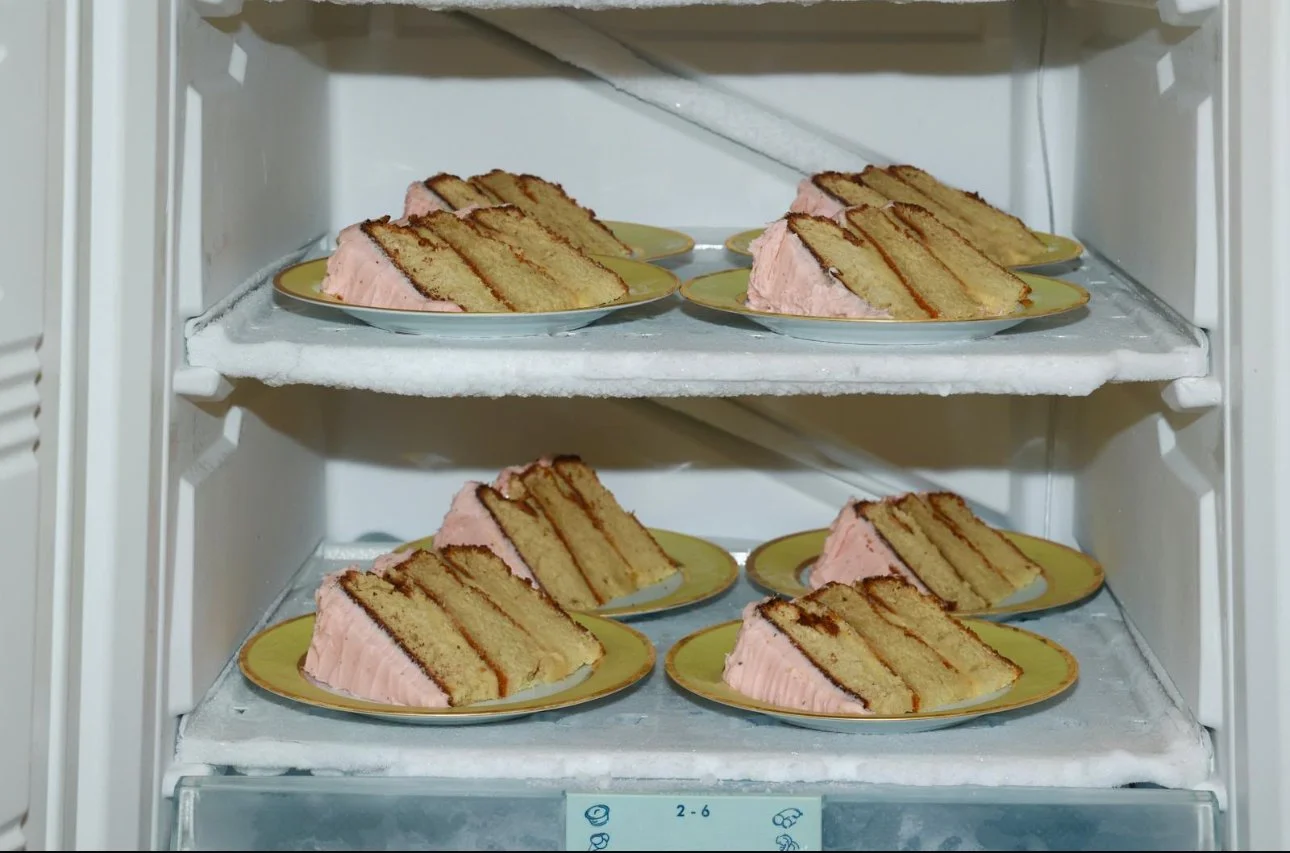
Alongside this research, I've been working on a personal project with my mother that takes Thiebaud's cake paintings as a starting point rather than something to simply admire from a distance. Instead of writing about his work from the outside, we tried to build our way into it — literally baking the cakes he painted, then photographing them as a way of testing what his brush was doing with a camera instead.
That meant treating baking as image-making from the start. We sourced the ingredients and stands to get proportions and shapes close to his compositions, and then spent real time on the details that make his paintings sing: the exact gloss level of icing (his surfaces read as thick, almost wet, never matte), the specific palette of pastel-into-saturated color he used, and lighting that could recreate that flat, bright, almost theatrical diner-case glow rather than soft ambient light. Getting the icing to hold a believable sheen under hot lighting without melting was its own small battle — as was matching his slightly exaggerated, candy-bright color story without tipping into looking artificial.
The result is a small series of photographs that sit somewhere between homage and translation: not photographs of Thiebaud's paintings, but photographs built from the same raw material — cake, color, light, sugar — pushed toward his aesthetic through a different medium. It's been a way of understanding his technique from the inside, one buttercream rosette at a time, and a genuinely fun excuse to spend an afternoon in the kitchen with my mum in the name of art history.